 WI
WIMethods
Experimental design and analysis
The study combines physical separation of individual flies, independent measurement of the electromagnetic environment, and statistical controls for the behavioural response shared across the plate.
Behavioural recording
-
Plate
Each plate contains 48 wells arranged in six rows by eight columns, with one fly per well. PETG, steel and aluminium versions share the same geometry.
-
Tracking
Zantiks video tracking provides per-well distance travelled and mean squared displacement in fixed time bins. Higher-temporal-resolution recording is planned.
-
Stimulus
Scheduled light-to-dark and dark-to-light transitions are applied to the complete plate. These transitions provide a precisely timed common stimulus for the analysis.
-
Custom plates
Custom plates are produced by 3D printing. Their approximately 11 mm well footprint can accommodate cavities for permanent magnets or shielding.
Electromagnetic measurements
Electromagnetic properties were measured independently of the behavioural analysis.
-
Coupling
Loop-to-loop coupling was measured with a PicoScope 5000 Series instrument using coherent averaging and damped-sinusoid fitting. A ring resonance was observed at approximately 31–34 MHz.
-
Plate transmission
S21 measurements from a vector network analyser were compared for steel and aluminium plates, together with calculations of skin depth and surface impedance. Steel showed greater sub-gigahertz near-field transmission.
-
Exposure source
A Zener-diode broadband noise source drove a 10 cm loop antenna. A NoiseCom UFX7000 was used as an alternative generator.
-
Delivered field
The field at the plate was characterised at approximately 293 nT RMS, with the largest contribution in the 0.1–1 MHz band.
Analysis
The Python analysis pipeline operates on the raw per-well locomotion traces. Its components address the common stimulus response, background plate-wide covariance and the unit of experimental randomisation.
Analysis code and supporting files are available in the Zenodo archive.
-
sliding_coord.py
Computes the within-transition minus cross-transition statistic from Fisher z-transformed pair correlations. Inference uses permutation testing with max-statistic correction across sliding windows; a bootstrap variant provides confidence intervals.
-
beetle_gas.py
Estimates background common-mode activity away from transitions, allowing plate-wide drift and other shared variation to be distinguished from pairwise coordination.
-
coord_controls.py
Implements leave-out common-mode removal and recording-level inference, corresponding to the level at which plates were randomised.
Exposure and control plates were classified blind. The allocation key remained outside the analysis process until assignments had been fixed.
Planned experiment
A planned experiment introduces a static magnetic-field gradient across the plate. Under a resonant magnetic-coupling hypothesis, differences in local field strength would place flies in different wells at different Larmor frequencies and reduce coupling between them.
The design uses 10 mm N42 cube magnets, stacked in pairs and positioned at B2, B7, E2 and E7. These four wells are excluded from behavioural recording. Magnet-containing plates will be compared with otherwise identical sham plates.
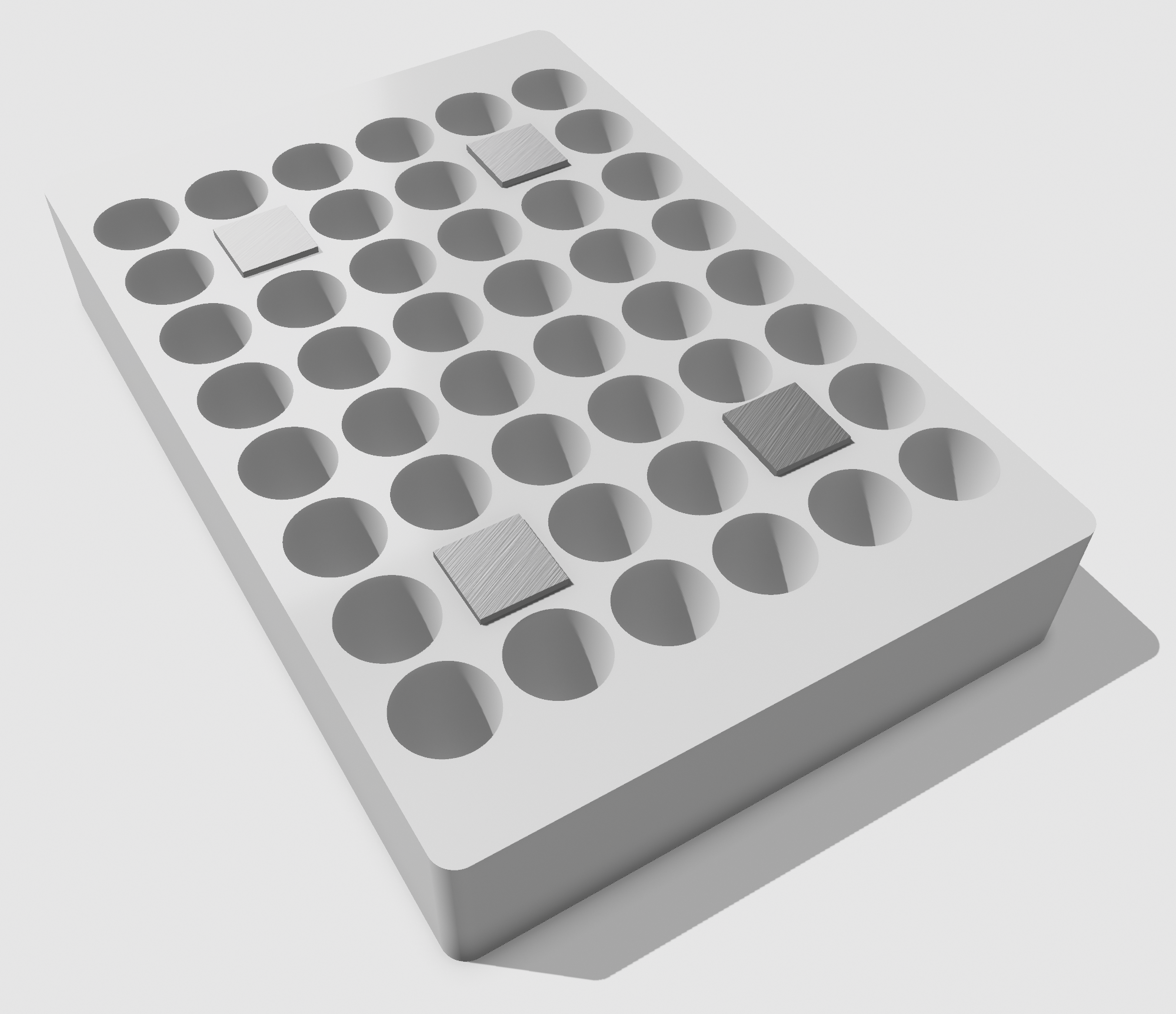
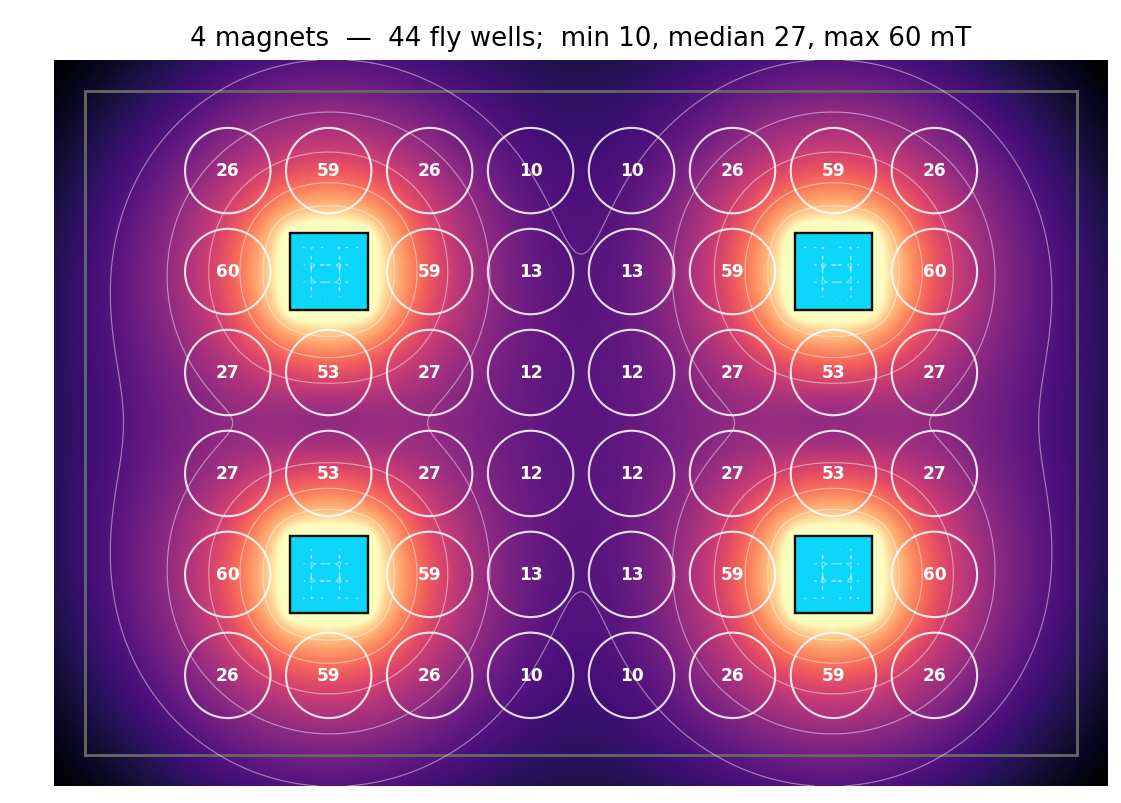
See Results for the completed experimental arms.