The Wi-Fly project is conducted by researchers at BSRC Alexander Fleming and SpinBio Ltd.
Katerina Douka
Research team
Makis Skoulakis
Research team
Luca Turin
Research team
How it Started
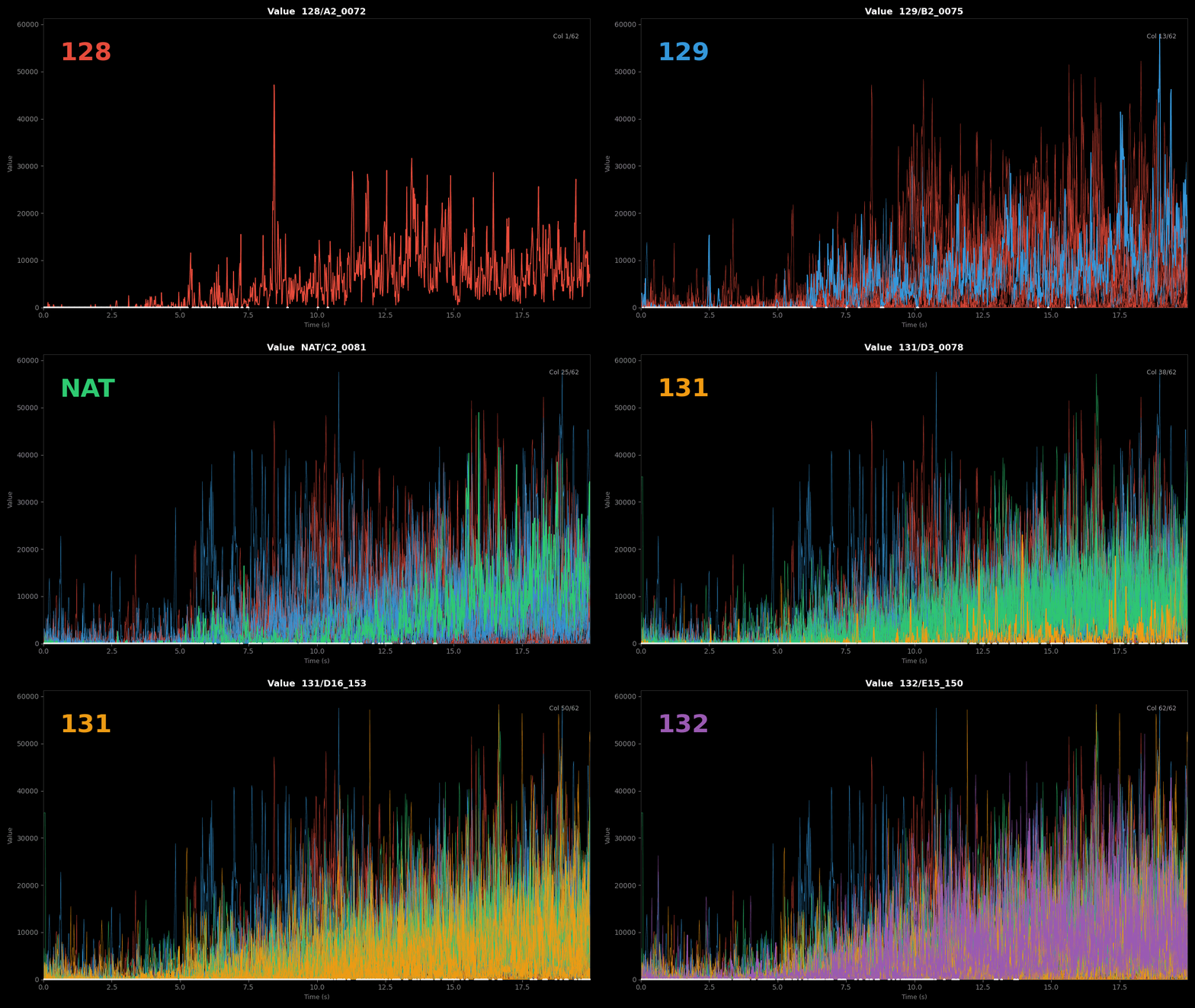
Each trace represents the change in pixels between one frame and the next (60 fps, 20 seconds, 1200 frames)of a digitized image of 40 flies waking up from anesthesia. The flies are in 90% Xenon under pressure. Different isotopes are used, indicated top left. Traces start at 2 atmospheres pressure. The x-axis is time in seconds. At t=0 the pressure is gradually lowered and the flies wake up, as can be seen from the broadly increasing pixel difference between one frame and the next. The frames where no pixel change occurs are indicated by white dots on the x-axis. In the beginning the flies are motionless and every frame makes a dot. Remarkably, even at later times when the flies have woken up there are frames where no motion occurs. This is a statistically improbable event, depicted in figure S1 of our BioRxiv paper.Data collected by Ekin Daplan, method described fully in https://www.jove.com/v/69671/validation-hyperbaric-pressure-system-with-xenon-anesthesia-for
 WI