 WI
WISeptember 2026
Xenon reversibly suppresses background coordination in isolated flies
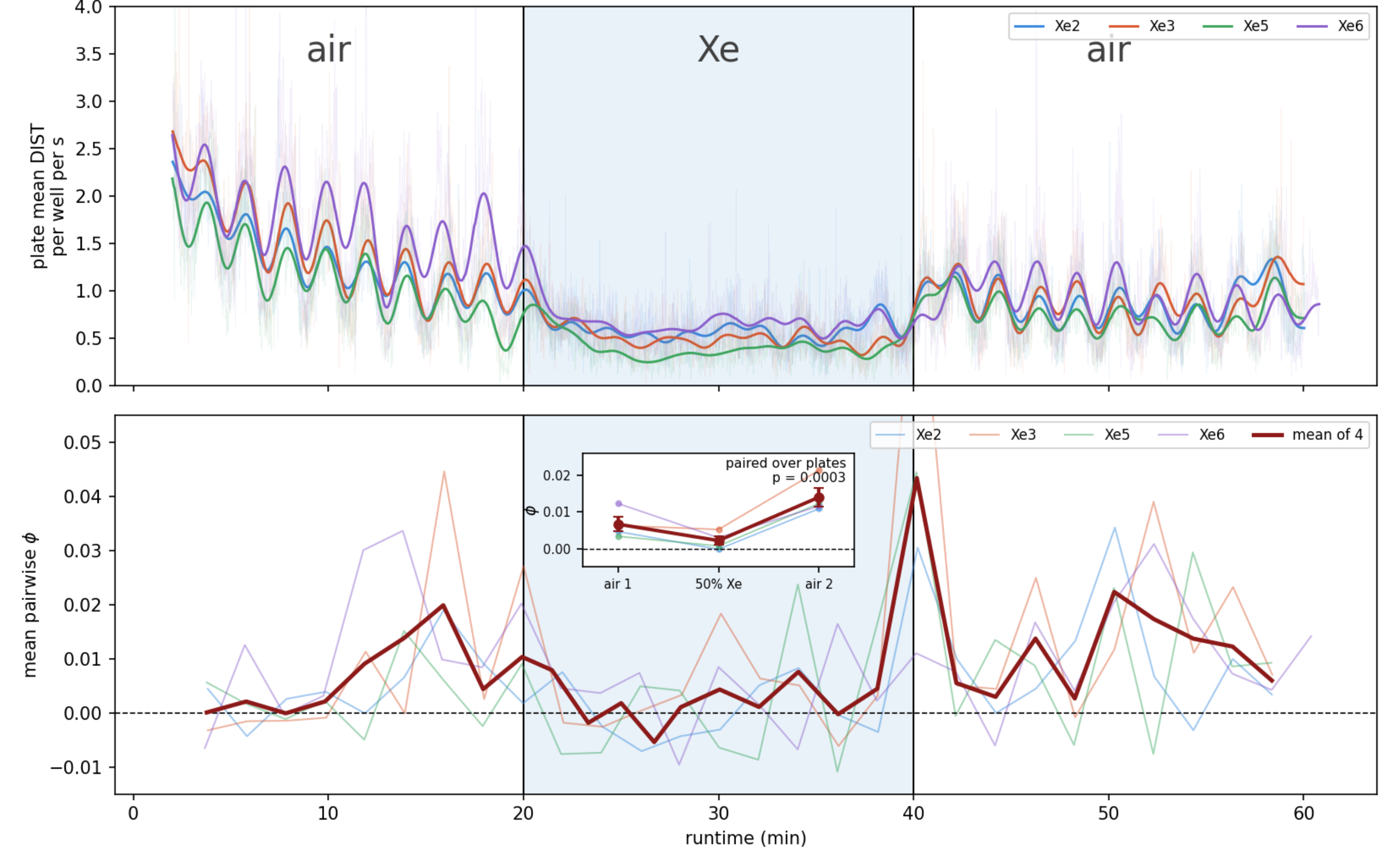
Flies housed individually in opaque wells normally show weak, shared fluctuations in movement even between the light-dark startles. To test whether this coordination depends on the animals' physiological state, we exposed four plates to 50% xenon for 20 minutes. Background coordination fell in every plate and recovered rapidly when air was restored (paired p = 0.0003). Xenon also reduced movement, but the two effects separated during recovery: locomotion returned only to 62% of its pre-exposure level, whereas coordination rebounded to 123%. The reversible loss and return of coordination therefore cannot be explained simply by changes in overall activity. This provides a pharmacological test of the phenomenon while leaving the physical channel between isolated wells unresolved.